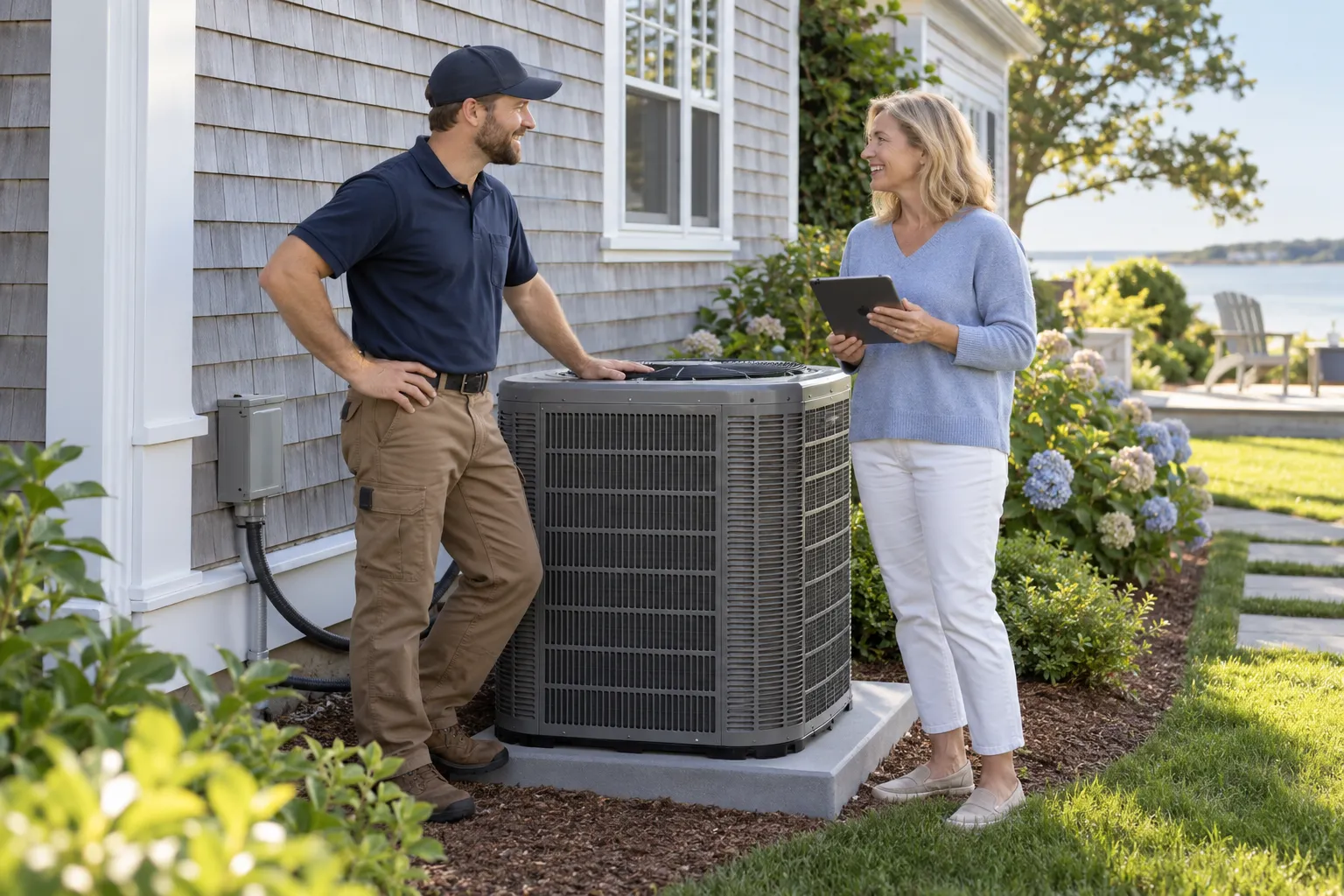
AC Installation & Replacement Services
Request an estimate today
An air conditioner does not fail the way a light bulb does. It fades slowly. It cools a little less each summer, costs a little more to run, and needs a few more repairs. At some point, a new system makes more sense than another fix.
Newspaperreported Heating & Air is a referral service. We explain what is likely going on, how the season and local weather affect the timing, and what to ask. Then we connect you with independent providers in our network. The providers visit your home, size the system, give you a written estimate and do the installation. You compare your options, with no obligation, and choose what fits your home and budget.
Is it time for a new AC or just a fix?
Think about an old car. One repair is normal. Three repairs in one year make you ask whether the money should go toward a newer one. Your air conditioner works the same way. A provider can look at its age, its repair history and its condition, then explain which path makes sense.
If the system quit during a hot spell, slow down, then act. Emergency AC repair may be the quickest way to get cool air back while you decide. Replacement is a bigger choice, and it goes better when you are not rushed.
Calm steps for the first hour
A warm house feels urgent. A short routine keeps you steady.
- Set the thermostat to cool and wait a few minutes. Some units restart on their own after a power blip.
- Check the breaker and the air filter. A clogged filter can shut a system down.
- Close blinds on sun-facing windows and run fans.
- Move babies, older adults and pets to the coolest room, and drink water.
- Switch the unit off if you smell burning or see water near electrical parts.
Then ask a provider to take a look. Try not to keep flipping the breaker, because that can harm the compressor.
Signs your AC may need replacing
A tired system leaves clues, much like a worn-out mattress that you only notice after a bad night. Watch for these:
- The unit is 12 to 15 years old, or older.
- Repairs keep coming back, one after another.
- Cooling bills climb even though your habits have not changed.
- Some rooms stay warm while others feel cold.
- You hear grinding, rattling or loud buzzing.
- The system uses an older refrigerant that has become costly to service.
One sign alone is not a verdict. Several together are worth an estimate.
Why the season changes the plan
Cooling is a bit like snow tires. It is easiest to arrange before everyone else is in a hurry. In cold, snowy regions, spring and fall are calmer times to book an installation. Providers are often less busy, and you can compare options without sweating through the decision.
In mid-summer, many people need help at once, so scheduling can stretch out. That is not a reason to panic. It is a reason to plan and to ask about availability early. Season by season, a small plan beats a rushed one.
Types of cooling systems
Choosing a system is like choosing lighting. One big ceiling light covers a room. Small lamps cover each corner. Both work, in different homes.
- Central split system: an outdoor unit and an indoor coil send cool air through ducts.
- Heat pump: one machine that cools in summer and can also heat in cooler months.
- Ductless mini-split: a small outdoor unit feeds wall units in each zone. It suits older homes without ducts, Cape Cod style layouts and multi-family buildings.
- Window or portable units: fine for a single room, but not a whole-home answer.
Older housing often has tight spaces, so ask which type fits your walls and floors.
Why proper sizing matters
Imagine wearing shoes a size too big. You can walk, but it is awkward and tiring. An oversized AC cools the air fast, then shuts off before it pulls out the humidity. The house feels cool but clammy. An undersized one runs all day and still falls behind.
A careful provider uses a load calculation, not a guess. It looks at square footage, insulation, windows, sun exposure and ducts. A full basement, a stone or block foundation or an unfinished attic can all change the answer. The new unit should fit your house as it is today, not just copy the old nameplate.
What an installation includes
Think of replacing a water heater. The part you see is only the start. Scope varies, but a typical job may involve:
- Removing the old unit and recovering the refrigerant properly
- Setting a level pad for the outdoor unit
- Connecting refrigerant lines, the drain line and wiring
- Fitting the indoor coil and checking the ductwork
- Installing a thermostat
- Starting the system, testing airflow and showing you how it works
Ask for this list in writing so nothing is left out of the quote.
Request a callback to check provider availability in your area.
Matching the system to your home
A cooling system works like a pair of dancers. If one partner is old and the other is new, they may not move well together. The outdoor unit, the indoor coil and the blower should be matched so they share the work.
This is also a good moment to think about heating and cooling as one setup. If your furnace is also near the end of its life, some homeowners search furnace replacement near me and ask for both to be reviewed in one visit. Your provider can explain whether that makes sense. Ductwork matters too, since leaky or crushed ducts waste the new unit's effort.
Efficiency in plain terms
Efficiency ratings, such as SEER2, are like miles per gallon for a car. A higher number means less electricity for the same cooling. But the number on paper is not the whole story. Where summers are short, a very high rating can take longer to pay off than it would in a hot place. A heat pump may earn its keep because it works much of the year.
Ask the provider to explain the tradeoff using your own home and usage. Also ask whether any utility rebates may apply.
Planning for snow, ice and storms
Your outdoor unit lives outside all year. Winter ground that swells and settles can tilt a pad, and spring snowmelt can pool water around it. Coastal storms bring wind, salt and flying debris. Ask about a raised pad, a spot clear of roof runoff and a way to protect the unit. A little planning is like a good pair of boots: unexciting until you need them.
Questions to ask the provider
- How did you choose this size?
- Which brands and models are in the quote, and why?
- What does the quote cover, line by line?
- What warranty applies to parts and labor?
- Who handles permits and removal of the old unit?
- How long will the work take, and how should I prepare?
Ready to compare estimates?
Estimate first. Newspaperreported Heating & Air is a referral service, so the independent providers in our network do the visiting, quoting and installing. Tell us about your home and we will point you to a local provider. There is no obligation to hire anyone.
What's Included
Home Assessment
A provider checks your rooms, insulation, windows and ducts so the new system is sized to match.
Old Unit Removal
The worn-out equipment is taken out and its refrigerant is handled the proper way.
New System Setup
Outdoor unit, indoor coil, lines, drain and wiring are installed and connected.
Testing and Walkthrough
Airflow and cooling are tested, and you learn the thermostat and filter basics.
Typical AC Replacement Costs
Prices depend on home size, system type, ductwork and local labor. These are typical U.S. ranges only, and every job differs, so always ask each provider for a written quote.
| Item | Typical range | Notes |
|---|---|---|
| Central AC replacement | $5,000 – $12,000 | Varies by size, brand and ductwork condition |
| Heat pump system | $6,000 – $15,000 | Cools and heats, so it replaces more than one unit |
| Single-zone ductless mini-split | $3,000 – $7,000 | Good for rooms or homes without ducts |
| Multi-zone ductless system | $6,000 – $14,000 | Price rises with the number of indoor units |
| Ductwork repair or changes | $500 – $3,500 | Needed more often in older homes |
| Thermostat and extras | $150 – $600 | Smart models and permits can add to the total |
How It Works
Tell us your situation
Share your home type, your current system and what is going wrong, using the simple request form.
Get matched with providers
We connect you with independent local HVAC providers who handle installations like yours.
Compare written estimates
Review system types, sizing, scope and price in writing, and ask any questions you have.
Schedule the installation
Pick a provider and a date that suits you, ideally before the hottest weeks arrive.
Why Call Newspaperreported Heating & Air
Explained before you decide
Learn what is happening and what your options are before anyone asks for a decision.
Independent providers
Local businesses in our network give the estimates and do the work.
Season-smart timing
Advice reflects local weather, so you can plan around heat waves and winter.
No obligation
Request an estimate, compare your choices and decide at your own pace.
Other Services
Need ac installation & replacement services in Jersey City?
Tell us what your system is doing. Request an estimate and a local provider in our network can follow up. No obligation.
No obligationAC Installation & Replacement Services FAQ
- How long does an air conditioner usually last?
- Many central systems last about 12 to 15 years. Care, climate and installation quality all matter, so a provider can tell you more about your unit.
- Should I replace my AC in spring or wait until it breaks?
- Spring and fall are often calmer times for providers, so scheduling can be easier. Waiting for a breakdown in a heat wave may mean fewer choices and more stress. If your unit is old, ask for an estimate early.
- Do I need to replace the indoor and outdoor units together?
- Often yes, because the parts are designed to work as a matched set. A provider can check your coil, blower and ducts and tell you whether a partial swap is sensible.
Reach a local provider
Tell us what your system is doing. Request an estimate and a local provider in our network can follow up. No obligation.
No obligation